
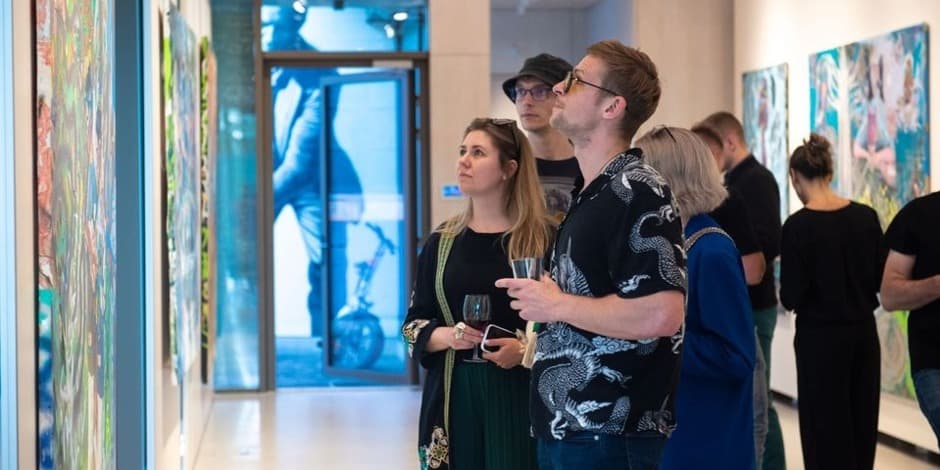
Tour at Tadas Tručilauskas' exhibition "A human and a machine"
We kindly invite you to a tour at Tadas Tručilauskas' exhibition "A human and a machine". The tour will be led by the author himself and a gallerist Vilma Jankienė.
This is an event in English. Lithuanian speakers are welcomed an hour earlier, at 1.00 PM: https://www.facebook.com/events/3658849287669947
The young generation artist Tadas Tručilauskas uses mixed media in his work, but believes that a man himself is like the most complex machine on this planet. The person’s multidimensional mechanics is what the artist invites us to contemplate in the large-format painting exhibition “A Human and a Machine” at the AP Gallery in Užupis from 19 June to 16 July.
The artist Tadas Tručilauskas (b. 1994) is considered a representative of contemporary painting, primarily because of his creative methods. After receiving his Master’s degree in painting from the Vilnius Academy of Arts in 2021, he immersed himself in technological experimentation. Seeking inspiration from different cultures, as well as masterpieces of painting, photography and cinema classics, using various computer programmes, combining mixed media with classical painting methods, the author began to create a kind of subconscious collages. Appropriated, eclectic images reminiscent of street art, virtual reality or dreamlike surrealism, characteristic of the millennial generation living against the backdrop of never-ending computerised information traffic.
This is the source of the broad and diverse worldview of T. Tručilauskas, which is reflected in his latest exhibition "A Human and a Machine". In his paintings, man is depicted not only as a young, existentialist being seeking inner silence and tranquillity in a chaotic environment, but also as a kind of construct of the universe, a machine created by nature, or perhaps by God, consisting of complex mechanisms that are not fully known to science.
The metaphor of the transformer, the human-machine, is intertwined with spirituality in Tručilauskas’ work. Spirituality appears in various symbolic forms, for example, through portraits of the Buddha, the modelling of the figure of Christ and the holy family, and the representation of ritual circles in which one sits or dances.
The artist’s paintings are full of “effects” reminiscent of psychedelic (i. e. reflecting subconscious experiences) art - colourful, undulating, pulsating lines combine into optical elements, often playing with the viewer’s attention. Contexts, as if in a kaleidoscopic secret, are both hidden and unexpectedly revealed.